Retail desk · U.S. stocking partner for Maxforce 82 mg blend · 9 ingredients 60-day window from purchase +1 (302) 200-3480 1 of 9 amounts printed

Official product information

Who Maxforce Suits, and Who Should Check First

Adults only, three readers this jar suits, six it does not, and one whose question a gummy is the wrong shape to answer.

Written and reviewed by the Maxforce Editorial Desk · Last updated October 29, 2026

Quick answer

Maxforce suits adults who want a simple one-a-day gummy habit.

It is not for under-18s, people on beta-blockers, anyone with hormone-sensitive prostate cancer or anyone facing surgery soon. New or ongoing erectile trouble needs a clinician first.

Read the cautions in full.

18 and over, and nobody younger

Adults only, and what this page can honestly sort

One age rule with no exceptions, then three readers the jar suits, six it does not, and one whose question belongs somewhere else entirely.

Adults 18 and over. That is the whole of the age rule and it admits no discussion. The supplied pack puts healthy adults eighteen and over and stops there — for a product whose front panel reads “MALE ENHANCEMENT GUMMIES” and whose every gummy carries three grams of added sugar.

Before the criticism, the credit. This label prints a complete Supplement Facts panel with all nine members in descending order of weight, hedges its front claims as “May Support” against the FDA disclaimer in its own ruled box, names a distributor with a city and a phone number, and itemises the caffeine at 5 mg rather than burying it in the blend total. The problem here is quantity, not candour.

3 groups the label honestly serves

Three readers this jar genuinely suits

A simple daily habit, a small declared amount of caffeine, and a readable panel.

Someone who wants to read a label properly

This product rewards that, oddly. The panel is complete, the ordering rule is followed and one ingredient carries a printed figure — which together let you work out more about the blend than most blends allow. Whether you like what you work out is a different question.

Someone who wants a small, declared amount of caffeine

5 mg is declared and itemised, which is more than most products in this category bother to do. It is also a rounding error beside a cup of coffee, so it is a fact rather than a feature.

Someone buying it as a habit rather than as a treatment

One gummy a day with 3 g of sugar is not a demanding routine, and the jar makes no promise beyond “may support”. If that is the expectation you are bringing, the product matches it.

The first of those is the most defensible. FDA requires blend members to be listed “Indented underneath the name of the blend, you must list the ‘other dietary ingredients’ in the blend, either in a column or linear fashion, in descending order of predominance by weight.” Caffeine is fifth of nine with 5 mg printed beside it, so every row below it weighs 5 mg or less, and the first-listed muira puama extract — with three rows of at least 5 mg between them — is no more than 62 mg. Arithmetic on the printed label, and on most blends you cannot get to it at all.

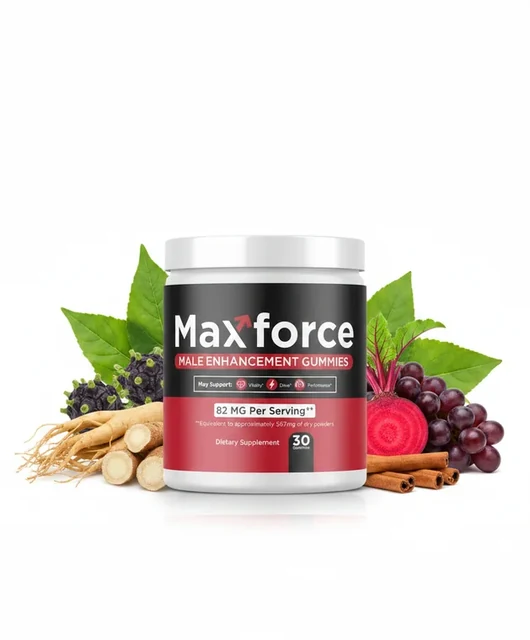
The Maxforce jar photographed with dried botanicals arranged behind it
Supplied with the pack. The botanicals arranged behind the jar are a styling device, not a portion: nothing in the photograph represents how much of anything is in a gummy. The whole blend is 82 mg.

4 groups named in one sentence

The warning panel, line by line

Pregnant, nursing, on medication, with a medical condition — the right four things to name, and the first two were not written for this jar.

The jar carries a real warning panel, and it repays being read line by line. Verbatim:

WARNING: If you are pregnant or nursing, take medications or have a medical condition, consult your doctor before using. Discontinue use and consult your doctor is any adverse reactions occur.

“If you are pregnant”

This is a product a man buys, and the first group its safety paragraph names is pregnancy. Not a safety failure, but a tell: the sentence is the standard four-part supplement warning, carried over unchanged rather than written for this jar. A panel written for the product in front of you would have named something else first.

“or nursing”

The same observation. Where the pair is not idle is the household rather than the buyer: NCCIH says of the ingredient at row six that it “Ashwagandha should be avoided during pregnancy and should not be used while breastfeeding.” Hence the storage line opening KEEP OUT OF THE REACH OF CHILDREN.

“take medications”

This is the line that does real work. NCCIH: “Dietary supplements may interact with your medications or pose risks if you have certain medical problems or are going to have surgery.” Two of the nine carry named interactions or blood-pressure notes on their federal pages. Take the jar to the pharmacist rather than the name of it; the panel is legible and it is the useful thing to hand over.

“or have a medical condition”

The broadest of the four and the most easily read past. NCCIH attaches named conditions to ashwagandha alone: it is “Ashwagandha is not recommended for people who are about to have surgery, or for those who have autoimmune or thyroid disorders.” and, the one that matters most on a product aimed at older men, “Because ashwagandha may increase testosterone levels, people with hormone-sensitive prostate cancer should avoid its use.”

One last thing, which is not about the panel’s content. Its final sentence reads “Discontinue use and consult your doctor is any adverse reactions occur” — the word should be if. Nobody is harmed by a typo; where it sits is what is worth a moment.
5 mg of caffeine, the one printed amount

Two small numbers worth knowing before you order

5 mg of caffeine the marketing card omits, and 3 g of added sugar the panel declares correctly.

If you are sensitive to caffeine

The panel itemises caffeine at 5 mg. Against FDA’s reference point that is negligible: “For most adults, the FDA has cited 400 milligrams a day — that’s about two to three 12-fluid-ounce cups of coffee — as an amount not generally associated with negative effects.” One eightieth of 400. FDA also prints the caveat that stops the figure being dismissed outright: “However, there is wide variation in both how sensitive people are to the effects of caffeine and how fast they eliminate it from the body.” And the green tea extract listed above it carries caffeine of its own, at an amount the label does not separately declare.

This belongs on a page about fit because of the second surface. The “Inside Maxforce” marketing card names five ingredients and caffeine is not one of them, so a buyer who reads only that card does not learn there is any caffeine in the jar at all.

If you are counting added sugar

Every gummy carries 3 g of sugar, all of it added sugar, at 6% of the Daily Value in 10 calories, and the instruction is one a day. MedlinePlus: “Men should get no more than 150 calories per day from added sugar (about 9 teaspoons or 36 grams of sugar).” So 3 g is about 8.3% of that ceiling — this desk’s arithmetic, not a federal statement. In fairness it is roughly three quarters of a teaspoon, and it is declared correctly on the panel.

6 exclusions, in order of consequence

Six groups it does not suit

Every one follows from a federal page or from the panel’s own ordering rule.

Anyone with erectile difficulty that is new or persistent

MedlinePlus is direct: “if you have ED, you should tell your doctor”, because “ED can be a sign of health problems. It may mean your blood vessels are clogged. It may mean you have nerve damage from diabetes.” And: “If you don’t see your doctor, these problems will go untreated.” FDA notes that health fraud scams “can lead to delays in getting proper diagnosis and treatment”.

Anyone expecting the amounts to match the research

They cannot. The whole blend is 82 mg across nine ingredients, and four of them are capped at 5 mg by the panel’s own ordering. NIH ODS discusses arginine at 2 to 20 grams a day.

Anyone with hormone-sensitive prostate cancer

NCCIH: “Because ashwagandha may increase testosterone levels, people with hormone-sensitive prostate cancer should avoid its use.” The amount here is capped at 5 mg, but this is a conversation for a clinician rather than a web page.

Anyone taking a beta-blocker or blood-pressure medication

NCCIH names an interaction between green tea at high doses and nadolol, and lists “increased blood pressure” among green tea extract’s side effects. Take the jar to a pharmacist.

Anyone about to have surgery, or with a thyroid or autoimmune condition

NCCIH: ashwagandha “is not recommended for people who are about to have surgery, or for those who have autoimmune or thyroid disorders.”

Anyone counting added sugar closely

3 g a day, every day. 6% of FDA’s Daily Value for added sugars, and about 8.3% of the 36 g MedlinePlus cites for men. Small, but it is a daily habit by design.

Five of those are settled by a federal page and the sixth by arithmetic on the label. Note what the list does not contain: any suggestion that the product is dangerous. A short interactive version lives on the home page — run the fit check — and the reasoning is here.

0 approaches shown safe and effective for this use

If the real question is a medical one

NCCIH’s verdict on the category is one sentence, and it points at a clinician.

There is a reader this page has been circling. If the reason you are on this website is that something has changed — recently, or persistently — the honest answer is that what you need is an appointment rather than a jar. NCCIH has a page on this exact category and it is the plainest sentence on this site: “No complementary health approaches have been shown to be safe and effective for sexual enhancement or treating erectile dysfunction (ED).” That is a verdict on the whole category from the federal centre whose job is to evaluate it, and it does not become less true for a product whose active total is 82 mg.

MedlinePlus explains why the appointment matters more than the verdict does: “ED can be a sign of health problems. It may mean your blood vessels are clogged. It may mean you have nerve damage from diabetes.” And the part men most often skip: “Some people have trouble speaking with their doctors about sex. But if you have ED, you should tell your doctor.” Those conditions have treatments, and the treatments do not begin until somebody looks. FDA puts the cost of a delay in one sentence: “Health fraud scams waste money and can lead to delays in getting proper diagnosis and treatment. They can also cause serious or even fatal injuries.”

The jar does not claim to treat anything: its wording is may support, hedged and disclaimed correctly. It is the reader, not the label, who decides which question he is asking.

Questions

Maxforce FAQ: who it is for questions

Who should avoid it?

On NCCIH’s ashwagandha guidance: anyone pregnant or breastfeeding, anyone about to have surgery, anyone with an autoimmune or thyroid disorder, and — because ashwagandha may raise testosterone — anyone with hormone-sensitive prostate cancer.

Is it suitable for under-18s?

No. The supplied pack says healthy adults 18 and over only.

Can I take it with my medication?

Ask a pharmacist. NCCIH: supplements “may interact with your medications or pose risks if you have certain medical problems or are going to have surgery.” NCCIH also names a specific interaction: green tea at high doses reduces the effectiveness of nadolol, a beta-blocker.

What should I do about erectile difficulty instead?

MedlinePlus: “if you have ED, you should tell your doctor”, because “ED can be a sign of health problems. It may mean your blood vessels are clogged. It may mean you have nerve damage from diabetes.” It adds that “Your doctor can offer several new treatments” and that “Getting more exercise, losing weight, or stopping smoking may also help.”

Is that a problem?

3 g is roughly three quarters of a teaspoon and it is correctly declared. It is a daily habit by design, though, and MedlinePlus cites 36 g of added sugar a day as the ceiling for men, so this is about 8.3% of that.

References

Sources for this page

  1. National Center for Complementary and Integrative Health. Dietary Supplements Marketed for Weight Loss, Bodybuilding, and Sexual Enhancement: What the Science Says. www.nccih.nih.gov. Accessed September 25, 2026.
  2. MedlinePlus, U.S. National Library of Medicine. Erectile Dysfunction. medlineplus.gov. Accessed September 25, 2026.
  3. National Center for Complementary and Integrative Health. Ashwagandha: Usefulness and Safety. www.nccih.nih.gov. Accessed September 25, 2026.
  4. MedlinePlus Medical Encyclopedia. Sweeteners - sugars. medlineplus.gov. Accessed September 25, 2026.

Read the exclusions before you order Maxforce

30 gummies a jar, one a day, thirty days a jar. A proprietary blend of 82 mg holding nine ingredients, of which one carries a figure of its own. 60 days from purchase to change your mind. Sales line +1 (302) 200-3480.

Price shown at checkout · 60-day window from the date of purchase · ships from inside the US · sales line +1 (302) 200-3480

Maxforce — 30 gummies, one a day $79, $69 and $49 a bottle were supplied · no pack is named for any of them · 60-day window
Order now