Official product information
82 mg, Nine Ingredients, and the Arithmetic the Label Gives Away
82 mg, nine ingredients, one printed figure and an ordering rule — and the six bounds that follow, with the working shown.
Written and reviewed by the Maxforce Editorial Desk · Last updated October 29, 2026
Quick answer
The Maxforce panel prints a Proprietary Blend of 82 mg holding nine ingredients, with caffeine itemised at 5 mg in row five. FDA requires the members to be listed in descending order of weight, so rows six to nine are each no more than 5 mg, and row one is no more than 62 mg. Those are derivations from the label, not estimates.
82 mg, the whole blend
One line on the panel decides everything else on it
Proprietary Blend, 82 mg, nine ingredients indented underneath it, and one figure among them.
The Supplement Facts panel on this jar declares one line that decides everything else on it: Proprietary Blend, 82 mg, and indented underneath it, nine ingredients. Muira puama extract, maca extract, catuaba extract, green tea extract, caffeine (5mg), ashwagandha, L-arginine, tribulus terrestris and horny goat weed extract. One number for all nine, and only the caffeine carries a figure of its own.
That is legal and it is worth saying so plainly before anything else. FDA’s own labeling guide requires a proprietary blend to print “the total weight of all ‘other dietary ingredients’ contained in the blend” and to list the members “in descending order of predominance by weight” — and it does not require the individual weights. This panel does exactly what the rule asks. The problem is not that the panel breaks a rule. It is what the rule permits a reader to be left with.
FDA’s requirement on the members is the one that matters here: “Indented underneath the name of the blend, you must list the ‘other dietary ingredients’ in the blend, either in a column or linear fashion, in descending order of predominance by weight.”
5 mg, the one printed amount
Caffeine is row five, and it carries a number
Everything listed below a 5 mg row weighs 5 mg or less. That is the whole trick, and this label handed it over.
And yet the panel gives away more than it means to, because of that ordering rule. The members must be listed in descending order of weight. Caffeine is the fifth of the nine and it is printed with its own figure: 5 mg. Everything listed after a 5 mg row must weigh 5 mg or less. So the four ingredients below it — ashwagandha, L-arginine, tribulus terrestris and horny goat weed extract — can each be no more than 5 mg. Not approximately. At most. That is not an estimate or an accusation; it is what the label says once you apply the rule it was printed under.
The same rule bounds the other end. The four rows above caffeine must each be at least 5 mg, so they account for at least 20 mg between them, and the first-listed ingredient — muira puama extract — can be no more than 62 mg (82 total, minus 5 for caffeine, minus at least 5 each for the three rows between them). The floor is arithmetic too: if row one were under about 14 mg, the three rows beneath it would be smaller again, the last four would still be capped at 5 mg each, and the nine could not reach 82 mg at all. So the honest range for the biggest ingredient in this product is somewhere between about 14 mg and 62 mg, and the four smallest are 5 mg or less apiece.
That working uses nothing except the label, and it produces ceilings rather than amounts: the honest form of words for row eight is no more than 5 mg, never 5 mg. The home page carries an interactive splitter for moving the eight unprinted rows around inside the 82 mg — try the blend splitter.
62 mg, the ceiling on row one
The arithmetic, row by row
Set out as a table it takes one pass to check. Both columns are derived from the same two facts, and row five is the only place a printed number enters.
| Row | Ingredient | Floor | Ceiling | How that follows |
|---|---|---|---|---|
| 1 | Muira Puama Extract | At least about 14 mg | No more than 62 mg | 82 less 5 for caffeine, less at least 5 each for rows 2 to 4 gives the ceiling. The floor follows from the other end: every row is capped by this one or by the 5 mg caffeine line, so nine rows cannot reach 82 mg unless this one is at least about 14 mg. |
| 2 | Maca Extract | At least 5 mg | No more than row 1 | Above the 5 mg row; below row 1. |
| 3 | Catuaba Extract | At least 5 mg | No more than row 2 | Same rule, one step down the column. |
| 4 | Green Tea Extract | At least 5 mg | No more than row 3 | Sits directly above the caffeine row. |
| 5 | Caffeine | 5 mg — printed | 5 mg — printed | The only itemised figure on the panel. |
| 6 | Ashwagandha | Above 0 | No more than 5 mg | Listed below a 5 mg row. |
| 7 | L-Arginine | Above 0 | No more than 5 mg | Same rule; also no more than row 6. |
| 8 | Tribulus Terrestris | Above 0 | No more than 5 mg | Same rule; also no more than row 7. |
| 9 | Horny Goat Weed Extract | Above 0 | No more than 5 mg | Last of the nine, so the lightest. |
No row other than five has a printed amount, and this site does not state one.
567 mg, the dry-powder equivalence
The 567 mg footnote, and what it cannot do
A whole-blend ratio of roughly 6.9 to 1, with no per-ingredient ratio behind it.
The jar answers the smallness with a footnote: “equivalent to approximately 567mg of dry powders”. Read as an extract-ratio claim that is about 6.9 to 1 across the whole blend. Two things about it. No per-ingredient ratio is printed, so it cannot be applied to any one row. And even if the whole 567 mg were credited and split nine ways, that is about 63 mg each — still far below the amounts in the studies the federal pages describe. NIH ODS is blunt about the general point: “U.S. law does not require dietary supplements to be standardized. In fact, there is no legal or regulatory definition of the term in the United States.” And: “Teas, tinctures, and extracts have different strengths from one another.”
The reason a whole-blend equivalence cannot rescue a single row is structural. An extract ratio is a property of one extract: this much concentrated material came from that much dried plant. Quoted across nine different extracts with no per-ingredient figure behind it, it does not say which of the nine carries the concentration. Row eight is capped at 5 mg of extract by the ordering rule, and the bound is on the extract because the panel weighs the extract.
2 to 20 grams, the arginine range
82 mg against the amounts the federal pages discuss
The bounds only mean something next to a scale. Three federal pages give one for three of these nine.
| Row | What this label permits | What the federal page discusses | In their own words |
|---|---|---|---|
| L-arginine | row 7, no more than 5 mg | NIH ODS discusses 2 to 20 grams a day | ODS: “The research to support supplemental arginine as a performance enhancer is limited and conflicting. Overall, it suggests that doses of 2–20 g/day arginine have little to no effect on performance in either anaerobic or aerobic exercise.” |
| Ashwagandha | row 6, no more than 5 mg | NCCIH’s trials use preparations dosed in the hundreds of milligrams | NCCIH: “Many clinical trials (studies in people) have looked at the use of ashwagandha for a variety of health conditions. However, many of the studies have had small sample sizes and have used a variety of ashwagandha preparations.” |
| Caffeine | row 5, 5 mg, printed | FDA cites 400 mg a day for healthy adults | FDA: “For most adults, the FDA has cited 400 milligrams a day — that’s about two to three 12-fluid-ounce cups of coffee — as an amount not generally associated with negative effects.” |
The comparison is not that the studied amounts work — on arginine ODS says the opposite. It is one of scale.
Read the arginine row twice: 5 mg is one four-hundredth of two grams. The caffeine row runs the other way and deserves saying plainly — 5 mg against 400 mg is small, declared and unremarkable.
5 of nine, on the marketing card
The card names five. The panel names nine
One more surface belongs here, because it is the one most buyers read. The “Inside Maxforce” card arranges five ingredients around the jar. The panel declares nine.
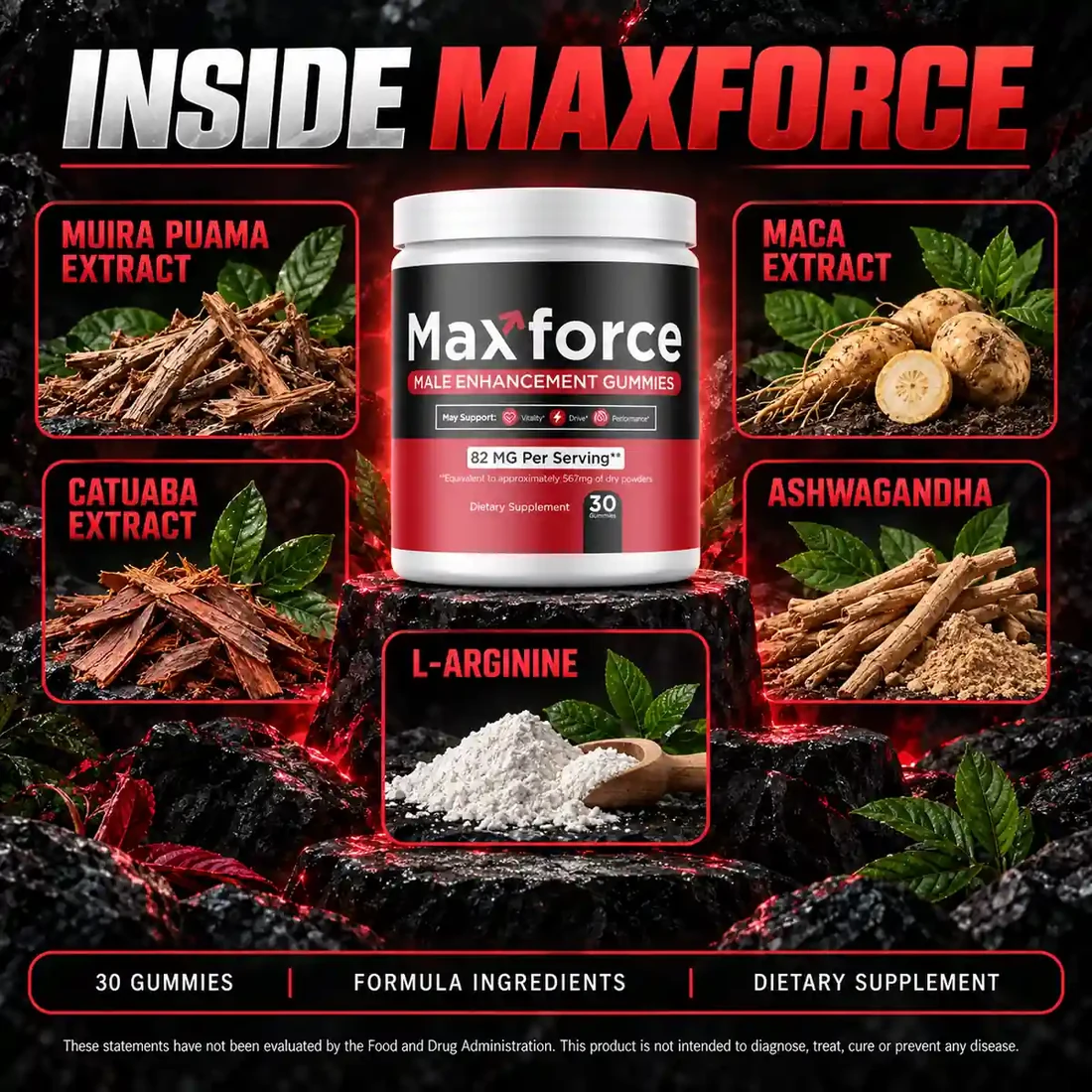
Count the ingredients on this product and you get a different answer depending on which surface you read. The Supplement Facts panel names nine. The pack text supplied to this desk names six — it leaves out L-arginine, tribulus terrestris and horny goat weed extract. And the “Inside Maxforce” marketing card shows five — muira puama, maca, catuaba, ashwagandha and L-arginine — dropping green tea extract, caffeine, tribulus terrestris and horny goat weed.
Unusually for this series, the label is the most complete of the three. The marketing is not adding ingredients that are not there; it is quietly omitting ones that are, including the two with the most loaded names on the list. A buyer who reads only the card does not learn that this product contains horny goat weed or tribulus terrestris, and does not learn that it contains caffeine. Read the panel. It is the only surface that has to be complete.
1 printed figure, six usable bounds
The rule worth keeping, and the credit due
Keep the rule rather than the numbers. On any proprietary blend, find a row that carries its own figure, and everything listed below it is capped by that figure. Most blends do not give you one. This one did, and it is the single most informative thing on the package.
A product that wanted to hide its proportions had an easy and legal option: print the total, list the nine, itemise nothing. Every bound on this page would then be unavailable. Instead the panel prints caffeine (5mg) in row five, which is a real piece of transparency and should be credited as one. The finding is still the finding — 82 mg across nine, not this is a scam — and the reason anybody can tell the difference is the figure the label chose to print.
Questions
Maxforce FAQ: the 82 mg blend questions
So you cannot tell me anything about the amounts?
More than you would expect, actually. Because the members must be listed in descending order of weight, and because caffeine is listed fifth with 5 mg printed beside it, everything listed after it can be no more than 5 mg. That caps ashwagandha, L-arginine, tribulus terrestris and horny goat weed at 5 mg each.
And the first ingredient?
Muira puama extract is row one, so it is the heaviest. It sits between about 14 mg and 62 mg. The ceiling is 82 total, minus 5 for the caffeine, minus at least 5 each for the three rows between them. The floor is the same rule read from the other end: every row is capped by this one or by the 5 mg caffeine line, so nine rows cannot add up to 82 mg unless this one is at least about 14 mg.
Is 82 mg a lot?
No. For scale, NIH ODS discusses L-arginine at 2 to 20 grams a day; this whole blend is 82 milligrams. The trials NCCIH describes for ashwagandha use preparations dosed in the hundreds of milligrams.
What does “equivalent to approximately 567mg of dry powders” mean?
It is an extract-ratio claim: 82 mg of extract presented as equivalent to about 567 mg of the raw dried plant, roughly 6.9 to 1 across the whole blend. No per-ingredient ratio is printed, so it cannot be applied to any single row, and even 567 mg split nine ways is about 63 mg each.
Which ingredients does the marketing card leave out?
Four: green tea extract, caffeine, tribulus terrestris and horny goat weed extract. A buyer who reads only that card does not learn the product contains caffeine.
Are the extracts standardised?
Not stated per ingredient. NIH ODS: “U.S. law does not require dietary supplements to be standardized. In fact, there is no legal or regulatory definition of the term in the United States.”
References
Sources for this page
- U.S. Food and Drug Administration. Dietary Supplement Labeling Guide: Chapter IV, Nutrition Labeling. www.fda.gov. Accessed September 25, 2026.
- NIH Office of Dietary Supplements. Dietary Supplements for Exercise and Athletic Performance. ods.od.nih.gov. Accessed September 25, 2026.
- National Center for Complementary and Integrative Health. Ashwagandha: Usefulness and Safety. www.nccih.nih.gov. Accessed September 25, 2026.
- U.S. Food and Drug Administration. Spilling the Beans: How Much Caffeine is Too Much?. www.fda.gov. Accessed September 25, 2026.
- NIH Office of Dietary Supplements. Botanical Dietary Supplements: Background Information. ods.od.nih.gov. Accessed September 25, 2026.
Next
Keep reading
See Maxforce on the official sales page
One blend line, nine ingredients, and one figure that makes six of them calculable. 30 gummies a jar, one a day, thirty days. 60 days from purchase to change your mind.
Price shown at checkout · 60-day window from the date of purchase · ships from inside the US · sales line +1 (302) 200-3480